
Women in STEM - Saint Hildegard of Bingen
A 12th Century Polymath exploring medicine, music, nature and the cosmos
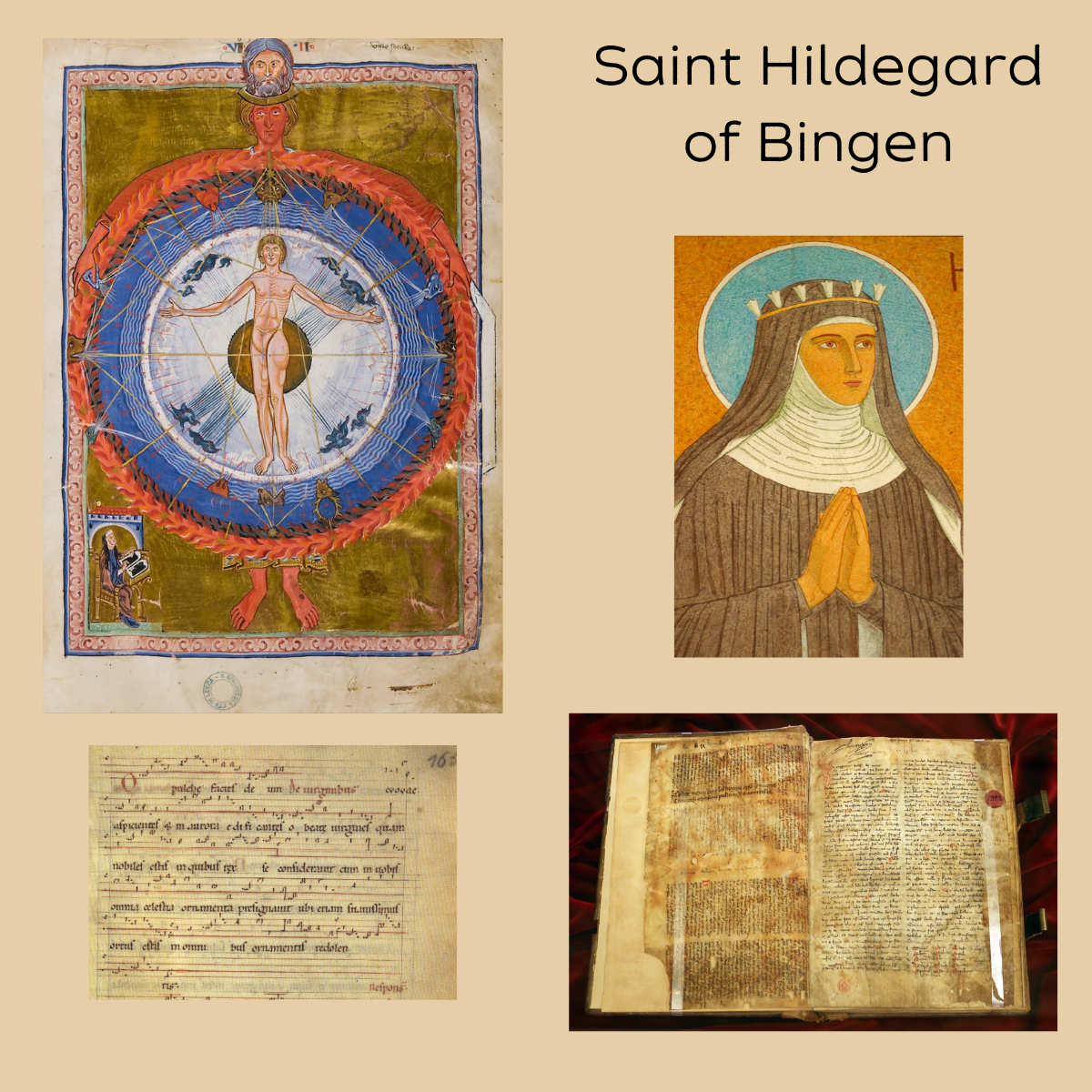
While researching Saint Hildegard of Bingen it became clear her body of work really is vast. She wrote on theology, medicine, plants, music, morality and the nature of the universe itself. Trying to condense all of that into notes for a single blog felt a little like trying to fit the ocean into a teacup.
Hildegard born 1098 in the Rhine region of what is now Germany. Entered religious life as a child, later becoming an abbess and eventually founding her own monastic communities. Over the course of her life she produced an extraordinary range of work. She wrote theological texts, medical observations, natural studies, poetry and music, while maintaining extensive correspondence with religious and political leaders. Because of the wide scope of works she is often described as a polymath and was sometimes referred to as the Sibyl of the Rhine and the Patron Saint of musicians and writers.
Central to Hildegard’s life were the visions she reported experiencing from childhood. She described seeing what she called the “Living Light”, vivid symbolic visions that she believed carried spiritual meaning. For many years she kept these experiences private, but in her early forties she consulted her confessor, who reported the matter to the Archbishop of Mainz. Subsequently her visions were examined by church authorities, including theologians who were appointed to assess their authenticity. She received papal encouragement and with the help of a monk she continued to record them.
These visions became the Scivias.
Scivias, written between around 1141 and 1152. The title comes from the Latin phrase meaning “Know the Ways”. In this text Hildegard described and interpreted a series of visions dealing with creation, humanity, moral life and the structure of the cosmos. The work was circulated within church circles and helped establish her reputation as a respected religious thinker.
Alongside her theological writing, Hildegard was also a talented poet and musician. A total of 77 surviving poetic works and accompanying music are attributed to her - Symphonia armonie celestium revelationum (“Symphony of the Harmony of Heavenly Revelations”), hymns, antiphons and a morality play titled Ordo Virtutum. Her music is known for its wide melodic range and expressive style, which makes it distinctive from the more restrained Gregorian chants of the period. The compositions appear to have been written to heighten the emotional and spiritual essence of her texts and are notable for the soaring melodies and dramatic shifts.
Hildegard wrote extensively about nature and medicine too. One of her works, referred to as Physica, examines plants, animals, stones and elements of the natural world. Describing their characteristics and possible uses in healing. The text reflects medieval ideas about balance in the body and the relationship between health and the natural environment.
Another medical work, Causae et Curae or “Causes and Cures”, explores the origins of illness and possible treatments. Hildegard discussed digestion, emotional wellbeing, reproduction and the influence of environment on health. Some sections address aspects of women’s health in ways that were revolutionary for the period.
Running through much of Hildegard’s thinking is the idea of viriditas. The word generally translated as “greenness” or “greening power”. She used it to describe the life force present in nature and within human beings. In her writings this vitality connects spiritual life, physical health and the natural world. Growth, balance and vitality all form part of the same living system.
Later in life Hildegard continued her theological writing. In Liber Vitae Meritorum, or “The Book of Life’s Merits”, she explored moral life through symbolic descriptions of virtues and vices. The work reflects on human behaviour and the ethical choices that shape a life.
Her final major visionary work was Liber Divinorum Operum, “The Book of Divine Works”, written between around 1163 and 1174. In this text she brought together many of the ideas present in her earlier writings. It presents a vision of the universe in which humanity, nature and the cosmos exist within a deeply interconnected order.
Hildegard died in 1179, leaving behind a remarkable legacy of writing, music and intellectual exploration. Her work crossed boundaries between theology, medicine, natural science and the arts. That breadth is one reason she continues to attract attention today. Her writings offer a glimpse of a twelfth century thinker exploring questions about health, nature, morality and humanity’s place within the wider universe.
Further reading
Britannica - Hildegard of Bingen